
Key takeaways
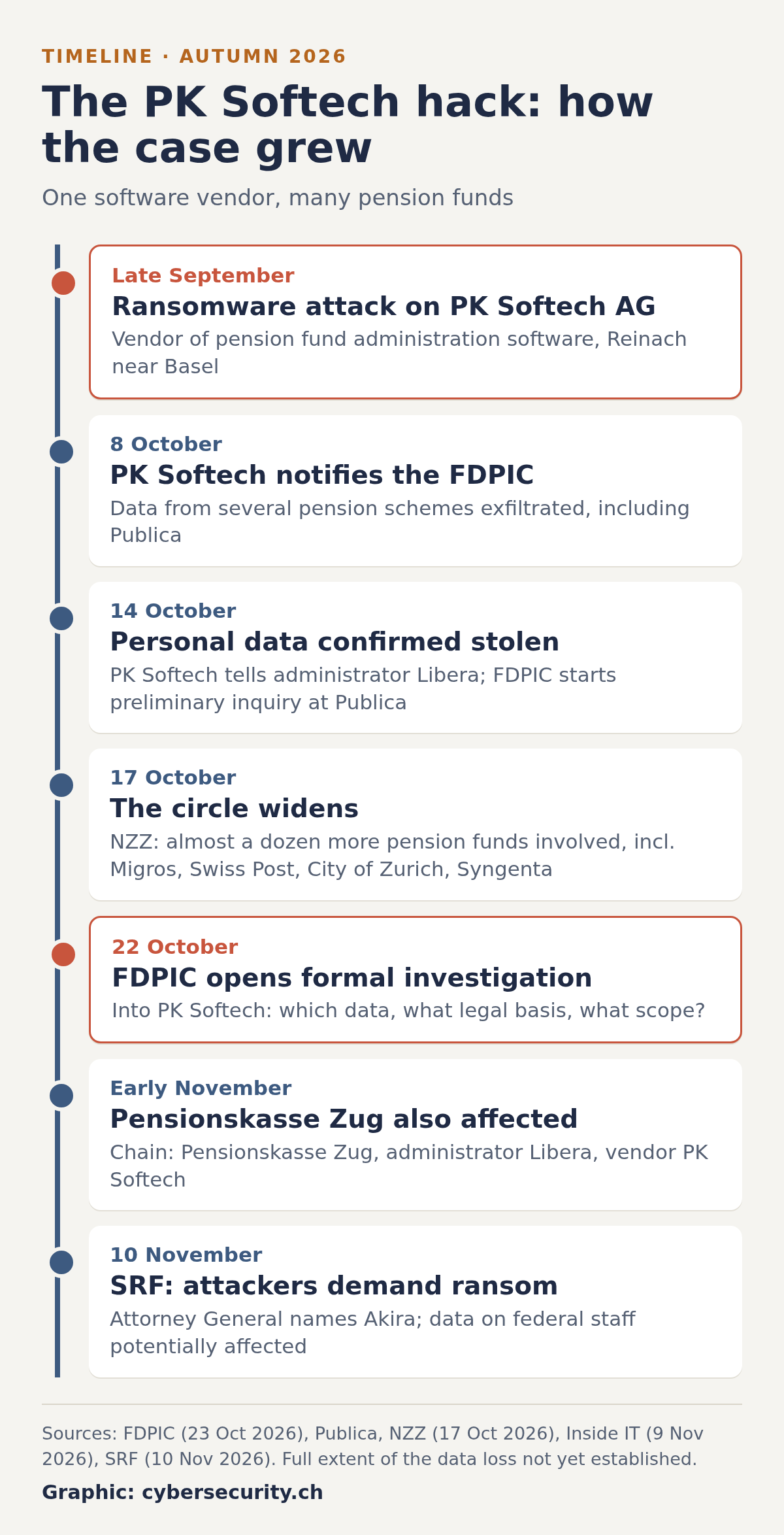
- In late September 2026, the Akira ransomware gang attacked PK Softech AG, a pension fund software vendor based in Reinach near Basel. Publica, the federal pension fund, is affected, and schemes including those of Migros, Swiss Post, Syngenta, the City of Zurich and Zug have been investigating or have confirmed possible data loss.
- Part of the data sat with the vendor because new software releases were tested with real member data. The Federal Data Protection and Information Commissioner (FDPIC) opened a formal investigation on 22 October.
- Swiss law is clear: outsourcing data processing does not outsource responsibility (Art. 9 FADP), and a processor must report every data security breach «as soon as possible» (Art. 24(3) FADP). A newly published court ruling also confirms the duty to inform the people affected.
- Our view: any company that hands payroll, customer or patient data to a supplier should check eight points now. The most important one costs next to nothing: no real data in a supplier's test environment.
As of Saturday, 14 November 2026. Investigations into the full extent of the data loss are still under way.
A supplier data breach is something many boards file under «covered by the contract». The attack on PK Softech AG shows how quickly it becomes your own problem. The Reinach-based company, just south of Basel, develops software for administering Swiss pension funds. Criminals got into its systems in late September, and since then one scheme after another has disclosed that member data sat with the vendor. Among them is Publica, the federal government's pension fund, with around 70,000 active members and 41,500 pensioners according to the NZZ.
The case shows where the chain between client and supplier tends to break: test data, subcontractors and informing those affected. Here is what is known, what Swiss law requires and what SMEs should take from it.
What we know so far
One attack, many victims
On 8 October PK Softech notified the FDPIC. From there, the circle widened quickly. By 17 October the NZZ counted almost a dozen further pension funds affected. Libera, a pension fund administrator, also confirmed that it works with PK Softech, and said the vendor first told it on 14 October that personal data had been exfiltrated.
The picture shifted along the way. The Bernese pension fund BPK told the NZZ it had to assume, «contrary to earlier information from PKS», that personal data had leaked. Pensionskasse Zug was informed in mid-October, believed it was not affected, and learned otherwise only in early November, Inside IT reports. It is not even a direct customer: its administration is outsourced to Libera, which uses PK Softech's software. A chain with three links.
According to Publica, the data potentially affected includes names, addresses, dates of birth, AHV (social security) numbers, phone numbers, email addresses and pension details, and for pensioners also their IBAN. Publica's own systems were not affected and pensions are being paid as normal.
Extortion, criminal case, regulator
According to SRF, the Office of the Attorney General names Akira as the perpetrator and has folded the case into existing proceedings over Akira attacks on Swiss firms. On 10 November SRF reported a ransom demand that the Federal Department of Defence (DDPS) was aware of. Data on the entire federal workforce could be affected, including intelligence and Fedpol officers working under false identities. PK Softech and Publica said they had received no demand, and there was no sign yet of the data being published.
On 22 October the FDPIC opened a formal investigation into PK Softech. It wants to establish which data the pension funds gave the vendor, on what legal basis, and how those transfers actually worked in practice.
The real problem: live data in test environments
Why did a software vendor hold so much personal data? Publica is candid: before new releases, the software is tested on special cases, and data was available to the vendor for that. The City of Zurich's pension fund is not even a customer yet but is preparing to switch in 2027, the NZZ reports. Its data was used to test the migration.
That is the heart of the matter. Production systems are usually well protected; a supplier's test environment often is not, even though it holds the same data. IT entrepreneur Jean-Pierre Kousz told the NZZ that in 95 per cent of cases the original member data is not needed for testing at all. Anonymising it takes effort, he said, so it is often avoided. Publica admitted to the NZZ that it had not carried out regular on-site security audits at PK Softech, although after the incident at government software vendor Xplain it had arranged for old data to be deleted.
None of this is new. In 2023, federal production data was stolen from Xplain and published on the dark web. The administrative inquiry found it had reached the vendor partly during testing and integration, and that the federal offices had not supervised their supplier adequately. Three years on, the story repeats in occupational pensions. It is less a technical failure than an organisational one, on both sides of the contract.
What Swiss data protection law requires
You cannot outsource responsibility
Art. 9 of the Federal Act on Data Protection (FADP) allows processing to be delegated to a processor. But the controller must «in particular ensure» that the processor can guarantee data security, and the processor may only pass the work on to a third party with prior authorisation. Anyone who intentionally outsources without meeting these conditions faces a fine of up to CHF 250,000 under Art. 61 FADP, and under Swiss law that fine targets the responsible individual, not the company.
Who reports what to whom?
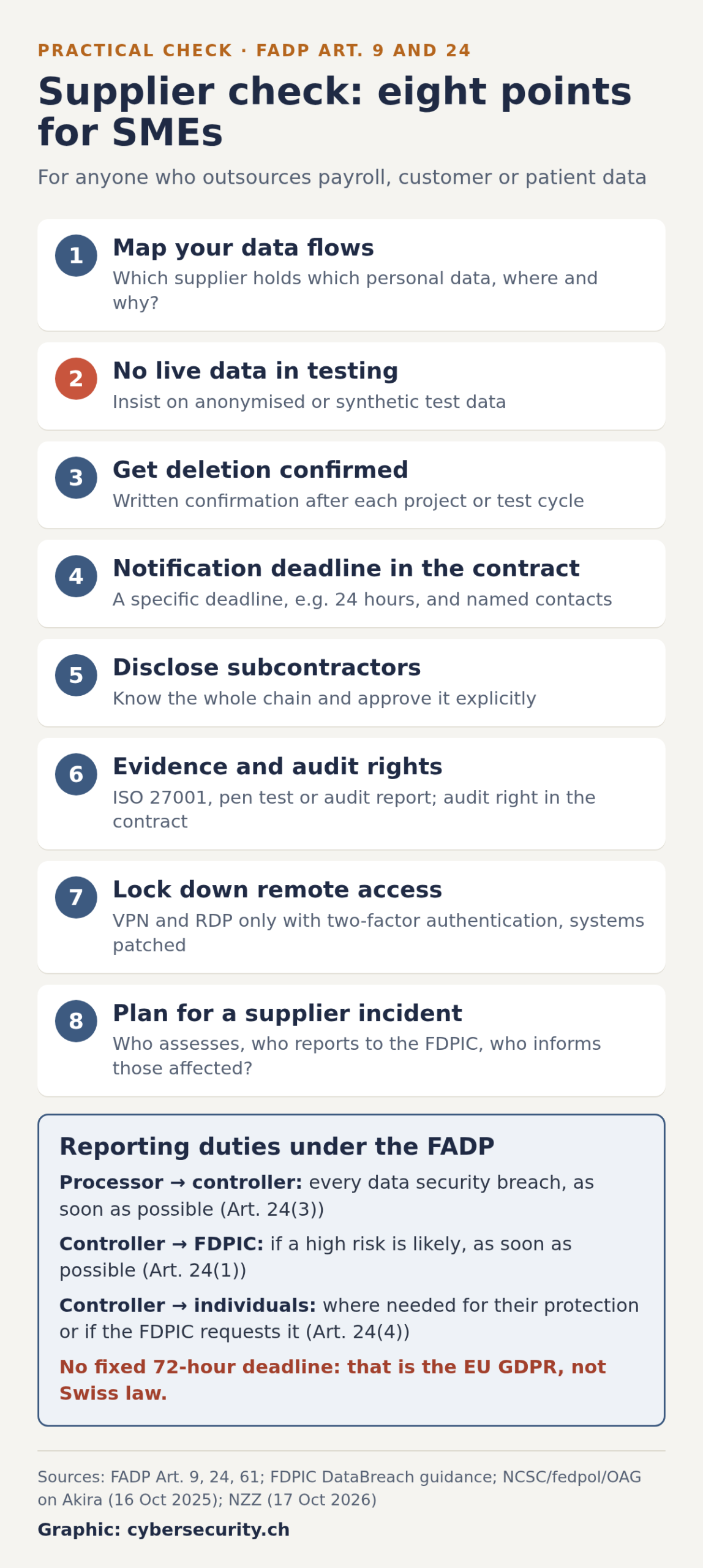
- Processor to controller: every data security breach, as soon as possible (Art. 24(3) FADP). The FDPIC's guidance stresses that this duty does not depend on a risk assessment.
- Controller to FDPIC: as soon as possible if the breach is likely to result in a high risk to the people affected (Art. 24(1) FADP). In ransomware cases, the guidance says, this may have to be assumed after an initial analysis; you cannot wait for lengthy investigations. Reports go through the FDPIC's DataBreach portal.
- Controller to individuals: where necessary for their protection or if the FDPIC requests it (Art. 24(4) FADP).
A common misconception: Swiss law has no fixed 72-hour deadline. That is a GDPR rule. «As soon as possible» can in practice mean even faster. Operators of critical infrastructure must additionally report cyberattacks to the NCSC within 24 hours, as explained in our article on the ISG and NIS2.
The lesson from the SkySale ruling
A decision the FDPIC published on 6 November shows how seriously the duty to inform is meant. At apfelkiste.ch, run by SkySale Schweiz GmbH, support links with customer data ended up in search engine indexes, for around eight months and in at least 19,000 cases including IBANs, according to datenrecht.ch. The company closed the gap but did not tell its customers. The FDPIC ordered it to do so, and the Federal Administrative Court upheld the order (judgment A-3790/2024 of 8 April 2026): fixing the problem after the fact does not remove the duty to inform. Because SkySale could no longer identify those affected, it may inform them publicly.
«We've plugged the leak, so we don't need to tell anyone» is therefore not a defensible position. People need to be able to protect themselves, for instance against phishing or fraud using their bank details.
The supplier check: eight points for SMEs
Based on the FADP, FDPIC guidance, NCSC advice on Akira and the experts quoted by the NZZ. It applies equally to an SME's fiduciary, payroll provider, HR software or IT partner.
- Map your data flows. Which supplier holds which personal data, where and why? Without that list you cannot even tell whether a supplier breach affects you.
- No live data in testing. Insist on anonymised or synthetic test data. If real data is unavoidable: the bare minimum, with a fixed deletion date.
- Get deletion confirmed. After a project or test cycle, ask for written confirmation of deletion and follow up with spot checks.
- Put a notification deadline in the contract. The law says «as soon as possible». Write a specific deadline into the contract, for example 24 hours, with a named contact on each side.
- Disclose subcontractors. Ask to see the whole chain and approve subcontractors explicitly (Art. 9(3) FADP). The Zug case shows how much time an opaque chain costs.
- Evidence and audit rights. Ask for ISO 27001, penetration tests or an independent audit report, and secure a contractual right to audit.
- Lock down remote access. According to the NCSC, Akira usually gets in through unpatched systems and remote access such as VPN or RDP without two-factor authentication. That applies to your access and your supplier's.
- Plan for a supplier incident. Decide who assesses the risk, who reports to the FDPIC and who informs the people affected. A prepared template saves days in a crisis.
Supplier data breach: what to do when the notification arrives
- Ask for facts in writing: which systems, which data, what time frame, which of your records? Log the date and time of every update you receive.
- Don't wait for certainty: if a high risk is likely, report to the FDPIC and supply details later. Swiss law explicitly allows follow-up reports.
- Warn people specifically: anyone who knows an AHV number, address and salary can craft very convincing phishing emails or calls. Our article on fake commercial register emails shows what such scams look like.
- Don't negotiate with extortionists: the NCSC advises against paying a ransom or contacting the attackers. Involve the police and file a criminal complaint instead.
If your own network is hit, follow the steps in our playbook for the first 24 hours.
Our assessment
On the plus side, several pension funds have communicated openly, and the FDPIC is examining not just the attack but the data flows behind it. That is exactly where the lesson lies: a supplier data breach usually starts long before the attack itself, with the question of which data the supplier should be holding at all.
The weak point was not primarily a firewall but a habit: live data travels to the supplier because it is convenient, and stays there because nobody asks. A full security audit can easily cost CHF 35,000 or more, according to the NZZ, which is often too much for an SME. Three written questions to every supplier cost nothing: Which of our data do you hold? Who else has access? How quickly will you tell us about an incident?
If you don't get clear answers, that is an answer in itself. Service providers with many clients are a lucrative target: one break-in yields data from numerous clients, as PK Softech shows. For the authorities' view of the wider threat picture, see our analysis of the NCSC semi-annual report.
Sources
- FDPIC: EDÖB leitete nach Cyberangriff auf Softwarelieferant Abklärungen ein (German), 23 October 2026
- FDPIC: Datensicherheitsverletzung: Bundesverwaltungsgericht bestätigt Informationspflicht der Onlineshop-Betreiberin (German), 6 November 2026
- FDPIC: DataBreach guidance on reporting data security breaches under Art. 24 FADP (German)
- Publica: Cyberangriff: Was wir wissen und was nicht (German)
- NZZ: Immer mehr betroffene Pensionskassen (German), 17 October 2026
- Inside IT: Auch Pensionskasse Zug von PK-Softech-Hack betroffen (German), 9 November 2026
- SRF: Hacker fordern Lösegeld nach Angriff auf Publica-Lieferantin (German), 10 November 2026
- NCSC, fedpol, OAG: Cyberkriminalität: Hackergruppe AKIRA intensiviert ihre Aktivitäten (German), 16 October 2025
- datenrecht.ch (Walder Wyss): BVGer: Informationspflicht ggü. Betroffenen bei einem Data Breach (German), 4 June 2026
- Federal Council: Abschluss der Administrativuntersuchung zum Hackerangriff auf die Xplain AG (German), 1 May 2024
- Fedlex: Federal Act on Data Protection (FADP), SR 235.1, Art. 9, 24 and 61
Stay informed
New analysis on cybersecurity in Switzerland, straight to your inbox. No spam, unsubscribe anytime.
