
Key takeaways
- After several data breaches, scam messages containing real names, booking details or AHV (social security) numbers are circulating in Switzerland. The National Cyber Security Centre (NCSC) warned about this personalised phishing on 17 November.
- Those targeted include around 8,200 customers of the Swiss holiday cooperative Reka (via WhatsApp), guests of the Kempinski hotels in St. Moritz and Engelberg, and workers registered with the household staff platform quitt.
- At quitt, 17 days passed between the data leak and a targeted phishing wave. Reka only learned of its incident when customers reported suspicious messages.
- Our view: correct personal details no longer prove anything. Companies should tell customers in advance what they will never ask for, and keep a warning template ready.
As of Tuesday, 17 November 2026. Investigations into the causes at Reka and Kempinski are ongoing.
Phishing after a data breach is nothing new, but the last few weeks in Switzerland have shown just how effective it has become. On Sunday 15 November, customers of Reka, the Swiss travel cooperative, received WhatsApp messages about the holidays they had booked, some including correct personal details and travel dates. They were asked to check or confirm their booking via a link. «It was crazy, they had the exact booking details and names», one recipient told the Swiss news site 20 Minuten.
Reka is not an isolated case. The NCSC, Switzerland's Federal Office for Cyber Security, devoted its weekly review of 17 November to exactly this pattern, and its advice sums it up: a message containing your correct name, address or other personal details «does not mean it is genuine». Here is what happened, why these messages work, and what businesses should prepare now.
Four cases, one pattern
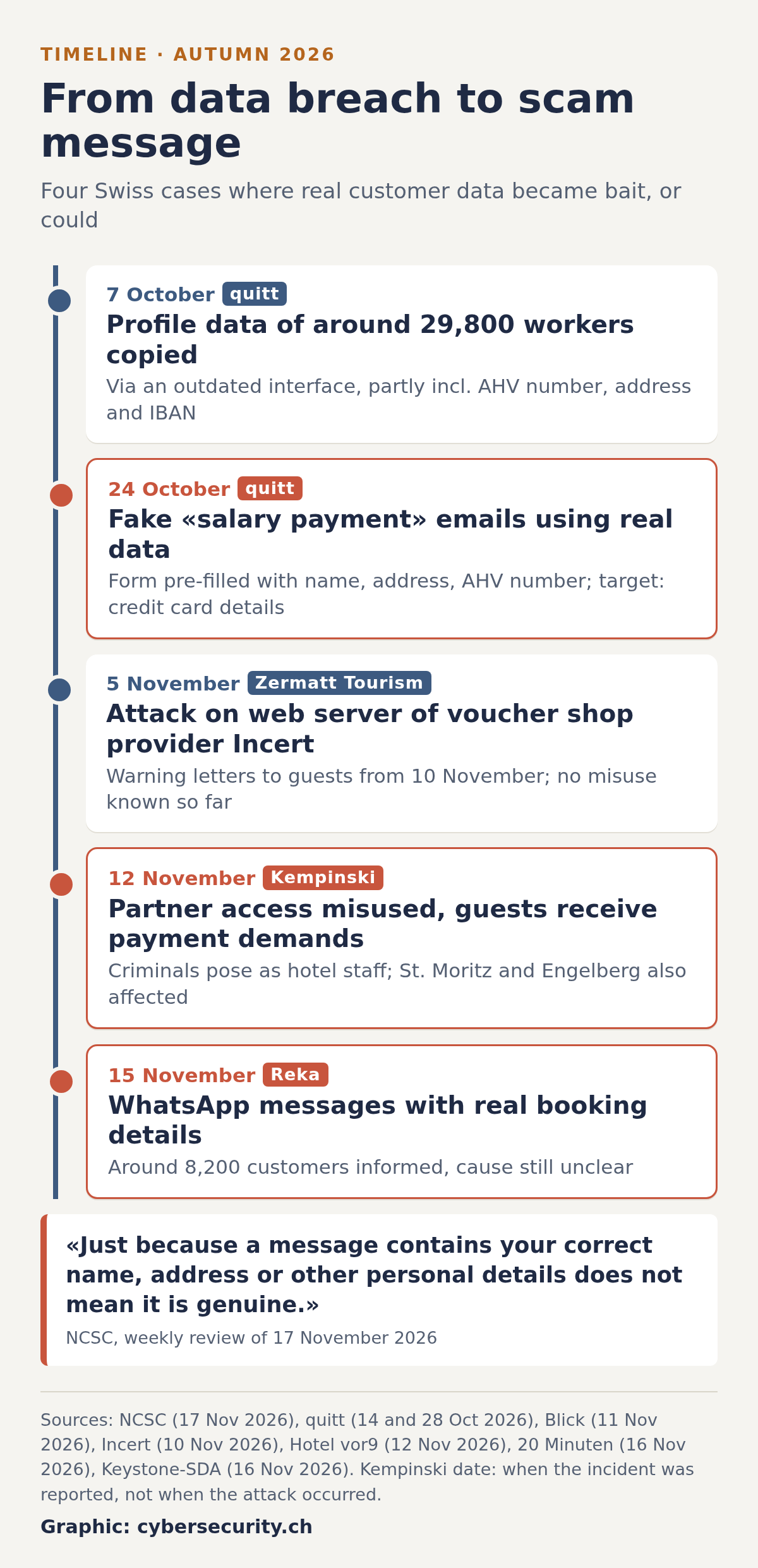
quitt: 17 days from leak to phishing wave
The NCSC does not name the company in its example, but the details match the incident that Zurich-based platform quitt disclosed itself. Private households use quitt to employ and pay domestic staff. On 7 October, an unauthorised party created fake employer accounts in bulk and, through an outdated interface no longer in use, copied the profile data of around 29,800 workers, in some cases including AHV number, date of birth, address and email, and for roughly half of them the IBAN. quitt reported it to the Federal Data Protection and Information Commissioner (FDPIC) and the NCSC and informed those affected from 13 October.
The sequel came on 24 October. Fake emails titled «Aktualisierung für Ihre Lohnauszahlung» (update to your salary payment) claimed that an outstanding wage of CHF 186.50 could only be paid once recipients confirmed their identity, AHV number and IBAN and entered a card in their name. According to the NCSC, the form behind the link was already pre-filled with name, address and AHV number. The real target was credit card details, including the security code.
Kempinski and Zermatt: the route runs through suppliers
Kempinski says an access credential used by an external technology partner was misused to reach guest reservation data. The criminals then contacted guests, posed as hotel staff and demanded payment. The data includes names, phone numbers, email addresses and booking details such as dates of stay and booking numbers. Kempinski confirmed to 20 Minuten that its hotels in St. Moritz and Engelberg are affected. Card data was not stored in that system.
Zermatt Tourism's case is similar, though no misuse has been reported. Its voucher shop is run by the Austrian provider Incert, which detected unauthorised access to a web server on 5 November. Names, dates of birth, addresses, contact details and voucher codes may have been copied. From 10 November, Zermatt Tourism wrote to potentially affected customers warning them about fraud attempts by email or phone, and it is monitoring voucher redemptions.
Reka: customers noticed first
The cooperative only found out when customers reported the fraudulent messages. Reka set up a crisis team, emailed around 8,200 people, filed a criminal complaint and posted a warning online. How the attackers got the data is still unclear. Director Roland Ludwig told broadcaster SRF that around 8,000 bookings for winter and summer holidays were affected. According to Ludwig, Reka's payment cards and Reka-Checks are not involved.
Why phishing after a data breach works so well
Phishing training teaches people to look for mistakes: a wrong salutation, clumsy wording, a booking that never existed. Personalised phishing sidesteps that check. It names the right holiday flat, the right arrival date, your own AHV number. That feels like proof, but only proves the data leaked.
Context does the rest. After booking a holiday, you expect to hear from the provider; if you work through quitt, you are waiting for your wages. An odd amount such as CHF 186.50 sounds more plausible than a round figure, and many people see WhatsApp as a private, trusted channel. We looked at how AI makes such messages even more convincing in our piece on awareness training and AI-driven phishing.
The NCSC adds that leaked data can be misused months or years later, and given recent thefts of AHV numbers, it expects more emails, texts and calls built on such data. That includes members of the pension funds whose data may have been caught up in the PK Softech supplier data breach. So far, Publica says it knows of no cases where people were contacted or harmed in connection with that attack.
Eight steps against follow-up fraud: what companies should prepare now
Most Swiss SMEs hold customer, booking or payroll data, often in systems run by suppliers. These points draw on the NCSC's recommendations and on what the companies above got right.
Before an incident
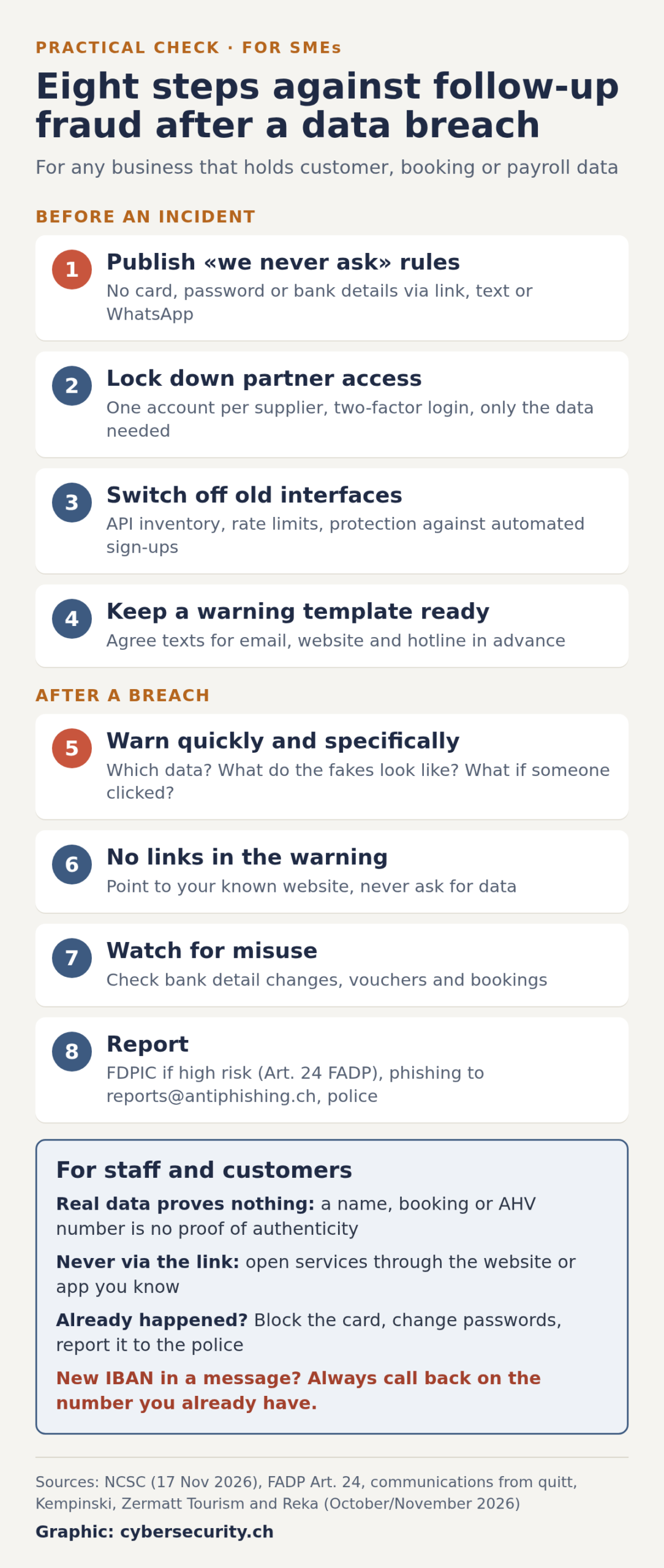
- Set and publish «we never ask» rules. Kempinski stresses that it never asks guests to pay via a link. quitt says it never asks for card details, passwords or bank details by email, text or phone. Such statements belong in booking confirmations, on your website and in signatures, before anything happens.
- Lock down partner access. Give every supplier its own account with two-factor authentication and access only to the data it actually needs. The Kempinski case shows what a single misused partner account can lead to.
- Switch off old interfaces. At quitt, the data left through an interface from an earlier version of the platform. An API inventory, rate limits and protection against automated sign-ups are basic hygiene.
- Keep a warning template ready. Draft texts for email, website and hotline calmly in advance, then fill in the facts when needed.
After a breach
- Warn quickly and specifically. quitt's warning was a good example: it described the subject line, the amount, the colour of the fake logo and the bogus contact details, with clear steps for anyone who had already entered data.
- Make sure your warning does not look like phishing. No links to «confirm» anything, no requests for data. Tell people to type in your website address themselves or log in to their account.
- Watch for misuse. Zermatt Tourism is checking unusual voucher redemptions, and quitt has stopped processing changes to personal data automatically for the time being. Bank detail changes need extra scrutiny.
- Report. Where a high risk to those affected is likely, Art. 24 FADP requires notification to the FDPIC. Individuals must be informed where this is needed for their protection, and a phishing wave using real data is exactly that situation. Phishing emails can also be forwarded to reports@antiphishing.ch, the NCSC's reporting address.
What staff and customers need to know
- Real data proves nothing. A correct name, booking number or AHV number is no sign of authenticity.
- Never via the link. Open online services through the website or app you know and check there.
- Change bank details only after a call-back. If accounts receives a new IBAN, call back on the number you already have, not the one in the message. It is the same principle we described in our article on fake commercial register emails.
- If it has already happened: have your card blocked straight away, change your passwords and report it to the police. Keeping quiet out of embarrassment only costs time.
Our view
The recent cases point to an uncomfortable shift. A data breach used to be treated mainly as a data protection matter, closed with a notification to the FDPIC and a letter of apology. Today it is often just the first act. The real damage starts when the data comes back as bait, in the name of the company that lost it.
That makes it a reputational problem too. Customers rarely distinguish between the company and criminals using its stolen data. What they remember is the company name on the message.
The good news: the companies involved communicated quickly and openly. Learning from them needs no big consulting project, just three decisions today: what your company will never ask for, who sends the warning if the worst happens, and which suppliers can reach your customer data, and with which accounts.
Sources
- NCSC: Week 46: Personalised phishing attacks using leaked data, 17 November 2026
- quitt (ServiceHunter AG): Medienmitteilung Sicherheitsvorfall quitt (German), 14 October 2026
- quitt help centre: Warnung vor gefälschten E-Mails im Namen von quitt (German), 28 October 2026
- Reka: Notice «Achtung: Betrügerische Nachrichten im Umlauf» (German), updated 15 November 2026
- Keystone-SDA via swissinfo.ch: Betrugswelle per Whatsapp trifft über 8000 Reka-Kunden (German), 16 November 2026
- SRF Espresso: Ferienanbieter gehackt: Vorsicht vor Phishing im Namen von Reka (German), 16 November 2026
- 20 Minuten: Reka warnt vor Phishing nach Hackerangriff: Betrüger kennen Buchungsdaten (German), 16 November 2026
- Hotel vor9: Kempinski warnt nach Cyberangriff vor Betrugsnachrichten (German), 12 November 2026
- 20 Minuten: Kempinski-Datenleck: Betrüger fordern Gäste als Hotelpersonal zur Zahlung auf (German), 16 November 2026
- Blick: Zermatt Tourismus meldet Cyberangriff - Kundendaten geklaut (German), 11 November 2026
- Incert eTourismus: Press release on the cyberattack (German), 10 November 2026
- Publica: Cyberangriff auf Softwarelieferanten (German), as of 16 November 2026
- Fedlex: Federal Act on Data Protection (FADP), SR 235.1, Art. 24
Stay informed
New analysis on cybersecurity in Switzerland, straight to your inbox. No spam, unsubscribe anytime.
