
Key takeaways
- An attacker took over a 1Password employee's corporate GitHub account, slipped their own code into backend services and copied account records for a subset of customers: names, email addresses, account identifiers and internal metadata.
- According to 1Password, vaults, stored passwords, Secret Keys and recovery keys were never within reach. The encryption held.
- The intrusion was spotted on 19 November and disclosed on the evening of 25 November. How many customers are affected, and how the GitHub account was compromised, is still unknown.
- For users, the real risk now is targeted phishing that uses genuine details. You do not need to change anything in your account.
- For companies, the lesson is about developer accounts: get into one and you can reach production.
The 1Password breach is the security story of the week. Within a day of the password manager confirming a break-in to its backend systems on Wednesday evening, more than 6,000 posts about it had appeared on X, and it became one of the week's most discussed threads on Reddit. No surprise there: a password manager sells trust, and here was an attacker inside its own infrastructure. The good news first: as far as anyone can tell, customers' passwords are safe. That does not make the incident trivial. Below we walk through what happened, day by day, and draw five lessons.
As of Thursday 26 November 2026, 14:00 CET. 1Password says it will update its notice if anything changes.
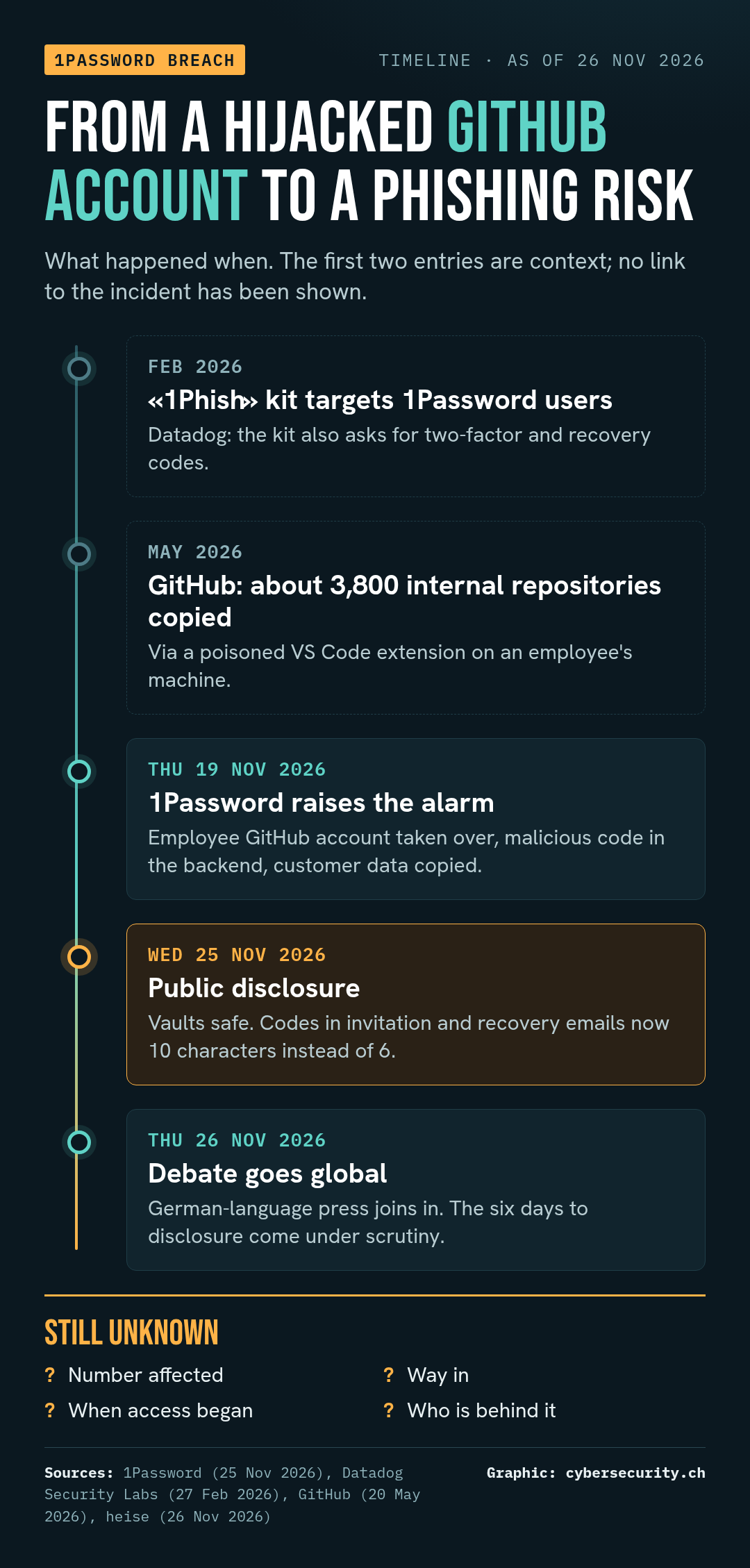
Timeline: how the 1Password breach unfolded
Based on 1Password's notice and reporting by BleepingComputer, TechCrunch, The Verge, heise and Golem. Where something is unclear, we say so.
February 2026: a phishing kit built for 1Password users
Datadog Security Labs analysed 1Phish, a phishing kit aimed squarely at 1Password customers. Between September 2025 and February 2026 it grew from a basic fake sign-in page into a multi-stage tool that also harvests two-factor and recovery codes. Its lures: emails claiming the account had been compromised. The scam existed well before there was a real breach to point to.
May 2026: developer accounts become the target
In May it was GitHub's turn: a poisoned version of the Nx Console extension for VS Code on an employee's machine let attackers copy around 3,800 internal repositories. According to the Nx developers, the malware swept up credentials, including GitHub tokens and active 1Password command-line sessions. Nobody has suggested a link to this week's incident, but it shows where attackers are looking this year: at developers' accounts and laptops.
Thursday 19 November: the alarm
1Password starts investigating signs that someone has taken over an employee's corporate GitHub account. Through it, the attacker reached source code, copied private repositories, got into the CI/CD system (the pipeline that builds and ships the software) and pushed their own code to backend services. That code downloaded administrative customer data. 1Password has not said when the attacker first got in.
Wednesday 25 November: the disclosure
Six days later, on the European evening, 1Password publishes «Update on a security incident involving 1Password's backend systems». By then, it says, it had disabled the account, revoked the stolen token, restored clean services and rotated every internal credential that might have been exposed. The headline messages: vault contents are untouched, customers need not change anything, watch out for phishing. As a precaution, the codes in invitation and recovery emails go from six digits to ten alphanumeric characters. Questions from TechCrunch and BleepingComputer about the number of victims went unanswered.
Thursday 26 November: the debate
heise calls it a variant of a supply chain attack. Online, the argument centres on two questions: why did disclosure take six days, and how much do metadata matter if the vaults are safe?
Still unanswered
- How many customers are affected
- How the GitHub account was taken over
- When the attacker first gained access
- Who is behind it
What was taken, and what was not
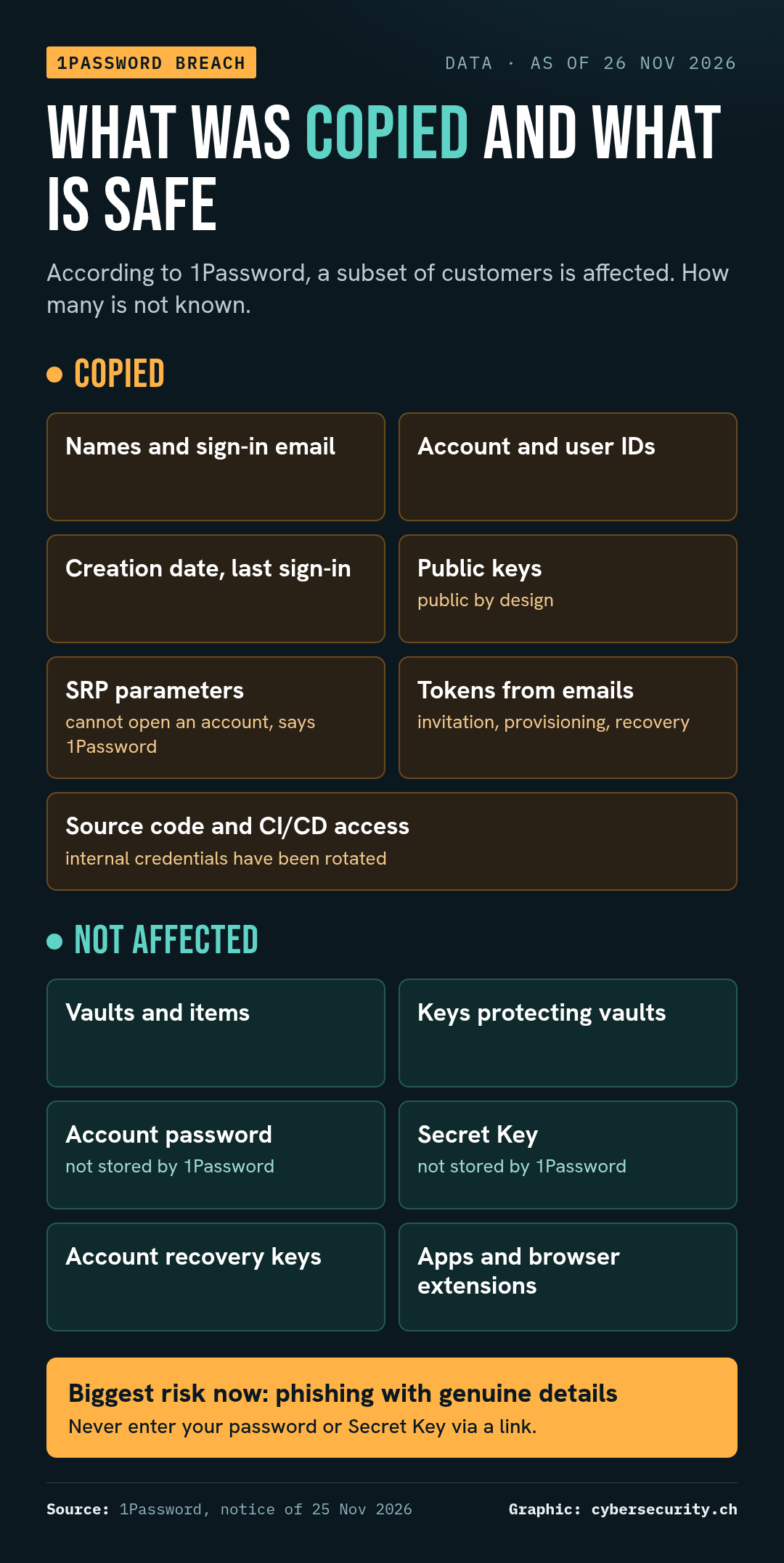
1Password's notice is unusually specific here. For a subset of users, the attacker copied:
- names and the email addresses used to sign in
- account and user identifiers, account creation dates and last sign-in times
- public keys, which are public by design
- parameters of the SRP sign-in protocol, which 1Password says cannot be used to access an account
- tokens from links in invitation, provisioning and account recovery emails
Not affected: the vaults and everything in them, the keys that protect them, the account password and Secret Key (1Password stores neither), account recovery keys, and the apps and browser extensions.
The tokens are the sensitive part. On their own they do not open an account; that also takes an SSO sign-in or a code sent to the registered email address, which until this week was six digits long. 1Password says only a small number of people had an invitation or recovery pending, and they have been contacted directly. It found no evidence of account takeovers.
Five lessons from the incident
1. The encryption did its job
1Password is built so that a break-in on its servers does not expose vault contents: vaults are encrypted with keys derived from the account password and the Secret Key, which only the customer holds. That scenario has now happened, and the design held. LastPass fared worse in 2022: attackers first took source code and later a backup containing encrypted vault data. The UK Information Commissioner's Office fined LastPass £1.2 million over it in December 2025.
2. A developer account is the new master key
The attacker did not have to crack a database. They had a GitHub account with enough rights to get code into production. heise summed it up neatly: why hack the database when you can rewrite the backend? For any company that builds its own software, accounts with write access to repositories and pipelines belong in the same tier as domain administrators. That means passkeys or hardware keys, short-lived tokens and protected branches with mandatory review.
3. The build pipeline is a vault that few treat like one
1Password itself says its CI/CD system holds infrastructure secrets so the product can work. Almost every software company is in the same position. If you keep cloud, database or code-signing keys there, you need to know which ones, and be able to rotate them in hours rather than weeks. Our piece on the ARTEX AI hacking tool shows how quickly attackers now exploit exposed keys.
4. «Only» names and emails still have value
«It's just contact details» does not quite hold here. The list shows who uses 1Password, since when and when they last signed in. That is enough for phishing emails that look alarmingly real, and the tooling already exists, as Datadog's analysis shows. We looked at how such follow-up campaigns play out, using Swiss cases, in Phishing After a Data Breach.
5. Six days is defensible; silence on the numbers is not
Six days passed between alarm and disclosure. For an investigation that first has to close access and rotate keys, that is not long. Less convincing is that 1Password still gives no figure for those affected and has not said how the account was compromised. A company that sells trust should fill those gaps. Customers forgive an incident more readily than the feeling that something is being held back.
What to do now
If you use 1Password personally or in a team
- According to 1Password, you do not need to change your password or Secret Key.
- Treat any email, text or call about 1Password you did not initiate as suspicious, especially «secure your account» messages, recovery requests or supposed Watchtower alerts.
- Only enter your password and Secret Key in the app or on the website you opened yourself, never via a link. You only need the Secret Key the first time you sign in on a new device or browser anyway.
- Turn on two-factor authentication for your 1Password account, ideally with a hardware security key.
If you administer 1Password for a business
- Check the People page for «Pending» entries you do not recognise, particularly if you use SCIM Bridge or Hosted Provisioning.
- Look out for a direct notification from 1Password.
- Give staff a short heads-up about fake 1Password emails. Two sentences in the team chat will do.
- In Switzerland, forward suspicious emails to reports@antiphishing.ch, the reporting address of the National Cyber Security Centre (NCSC).
If you build software yourself
- List every account with write access to repositories and pipelines, including bots and service accounts.
- Enforce phishing-resistant sign-in for those accounts and put an expiry date on access tokens.
- No single account should be able to push code to production on its own. Protected branches with mandatory review are the minimum.
- Do not let IDE extensions update automatically without control. The Canadian Centre for Cyber Security recommended exactly that after the GitHub incident in May.
Should you switch? Our view
We do not think this incident is a reason to change password managers. The core promise, that a breach at the provider does not give away your passwords, held up in a real emergency. Hurriedly exporting everything into a spreadsheet or the browser would make things worse, not better.
The more important question is not «Is 1Password still safe?» but «Who in our company can push code to production with a single account?»
It is still a wake-up call, mainly for companies with their own software. As far as we know, the attacker needed no spectacular flaw, just one developer account with too much reach.
For Swiss organisations using 1Password there is a data protection angle: the provider processes staff names and email addresses on their behalf. In our view, that data alone is unlikely to amount to a high risk under Art. 24 FADP requiring a report to the FDPIC. Record your assessment in writing anyway. How to assess incidents at service providers is covered in our piece on the PK Softech supplier data breach.
Sources
- 1Password: Update on a security incident involving 1Password's backend systems (25 Nov 2026)
- BleepingComputer: 1Password customer data stolen after employee GitHub account breach (25 Nov 2026)
- TechCrunch: 1Password said hackers broke into its internal systems, but customer passwords are safe (25 Nov 2026)
- The Verge: 1Password breach leaked customer names and emails, but not passwords (25 Nov 2026)
- heise online: 1Password: Kundendaten entfleucht (German, 26 Nov 2026)
- Golem.de: Hacker bei 1Password eingedrungen (German, 26 Nov 2026)
- Datadog Security Labs: Hook, line, and vault: A technical deep dive into the 1Phish kit (27 Feb 2026)
- GitHub Blog: Investigating unauthorized access to GitHub's internal repositories (20 May 2026)
- Nx: Postmortem Nx Console v18.95.0 supply-chain compromise (21 May 2026)
- Canadian Centre for Cyber Security: AL26-013 Security incident impacting GitHub internal repositories (29 May 2026)
- ICO: Password manager provider fined £1.2m by ICO for data breach (Dec 2025)
Stay informed
New analysis on cybersecurity in Switzerland, straight to your inbox. No spam, unsubscribe anytime.
