

Key takeaways
- Java4Shell (CVE-2026-114938) is a memory-corruption flaw in OpenJDK's Base64 decoder. It can let attackers run code over the network, in some cases without logging in.
- A system is only exploitable when four conditions meet: unpatched Java 17.0.6 or later, an x86-64 CPU with AVX-512 VBMI, the Base64 acceleration switched on, and Base64 data coming from outside.
- Fixes have been out since 17 November: 17.0.21.1, 21.0.13.1, 25.0.5.1 and 27.0.1.1. Every Java process has to be restarted afterwards.
- The Swiss NCSC (BACS) urges operators to check their exposure now. Attackers are already scanning for vulnerable systems.
- Our view: this is not another Log4Shell, but self-hosted Jira, Confluence, Keycloak or Jenkins servers on recent hardware should be dealt with this weekend.
Java4Shell is the Java vulnerability that has kept IT teams busy since Tuesday. Switzerland's Federal Office for Cyber Security (BACS, known in English as the NCSC) issued a warning on 18 November, telling operators to check their systems «immediately». Because Java sits inside countless programs and devices, often without anyone being aware of it, the first question is usually not «how do we patch?» but «where are we actually running Java?». Below we answer the questions Swiss IT leads are asking and give our take on how urgent this really is.
As of Saturday, 21 November 2026. The situation is moving; vendor guidance takes precedence over this article.
What exactly is Java4Shell?
Security firm Calif disclosed the flaw on 17 November, the same day Oracle and the OpenJDK project shipped their fixes. The bug is not in any one application but in the Java runtime itself, in a heavily optimised routine that decodes Base64 text. Base64 is everywhere: login credentials, tokens, SAML messages, file uploads.
On recent Intel and AMD processors, Java speeds this up with special AVX-512 instructions. In that code, a mishandled «=» at the end of the input causes around 62 bytes to be written past the end of the allocated buffer. According to Calif, 64 letter «A»s followed by one «=» are enough to trigger it. With considerable effort, that can be turned into a memory leak or code execution.
Severity scores differ: the OpenJDK project rates the flaw 8.1 out of 10 under CVSS 3.1, while Calif arrives at 9.2 under CVSS 4.0. Either way, take it seriously.
Am I affected?
This is where many organisations can breathe a little easier. Red Hat lists four conditions that must all be true at once:
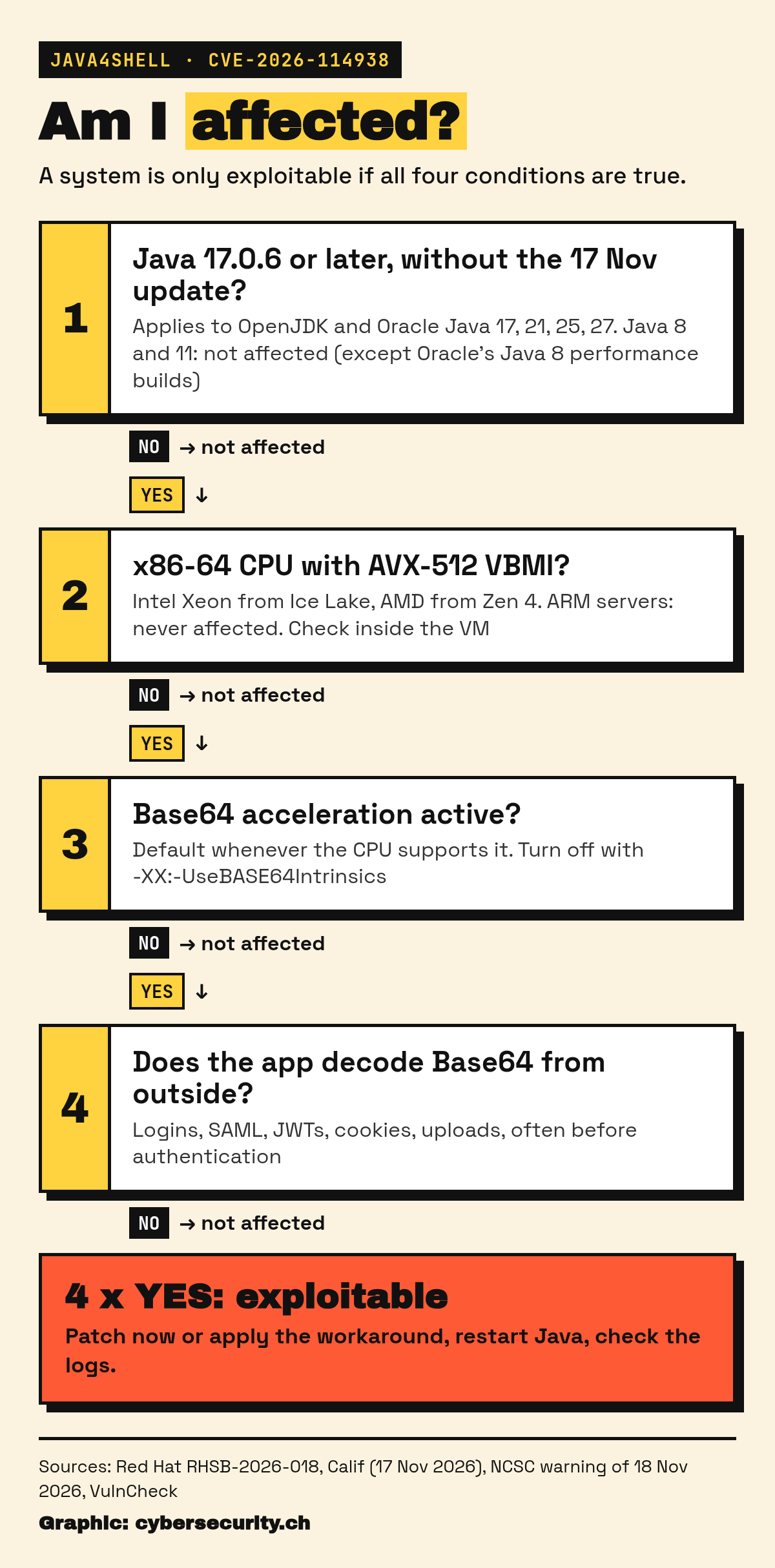
- Java version: OpenJDK or Oracle Java from 17.0.6 onwards, including 21, 25 and 27, without the 17 November update. Java 8 and 11 do not contain the faulty code, with the exception of Oracle's Java 8 performance builds.
- Processor: x86-64 with AVX-512 VBMI. That means Intel Xeon from Ice Lake on (including Sapphire, Emerald and Granite Rapids) and AMD from Zen 4, such as EPYC Genoa and Turin. ARM servers such as AWS Graviton are not affected, and neither are most current Intel laptops, which have AVX-512 disabled.
- Acceleration active: this is the default. Java picks the fast code path automatically whenever the CPU supports it.
- Base64 from outside: the application decodes data an attacker can supply. Typical examples are HTTP Basic logins, SAML, JWTs, cookies and uploads, often before authentication.
A note on virtual machines: what counts is which CPU features the hypervisor passes through to the VM. Checking the host's spec sheet is not enough, so test inside the VM or container itself.
Which applications are at risk?
Calif demonstrated unauthenticated code execution against default installs of Keycloak, Atlassian Jira and Confluence, JFrog Artifactory, Jenkins and PingFederate. With a valid login, it worked against Apache Kafka, Apache Solr, Elasticsearch, Gerrit and Spinnaker. Calif also showed it on sample apps built with Spring Boot and Apache Struts, and against Java programs that open a TLS connection to a malicious server.
The NCSC stresses that this list is not exhaustive and specifically mentions «banking software and other industry solutions». If you rely on a specialist application built on Java, ask your supplier.
Hardware is affected too. According to SecurityWeek, Cisco has confirmed more than a dozen products, including Catalyst Center, and had no fixes as of 19 November. Siemens advises taking three Industrial Edge Management products offline until patched. At Elastic, every Elasticsearch release from 7.17.3 onwards is affected; code execution needs read permissions, a crash does not.
Is it being exploited yet?
Scanning has started. By the morning of 19 November, GreyNoise had logged more than 150 matching requests from five IP addresses, with no successful intrusions on its sensors. watchTowr is seeing «blind» exploitation attempts with correctly shaped requests, and Cloudflare has observed scanners increasingly disguising their tools. At the time of writing, no confirmed compromise had been made public.
That is no reason to relax. Calif's own proof of concept only triggers the bug, but VulnCheck has been offering its customers a full exploit since 17 November. And Calif says one of its researchers found the flaw with AI assistance in an hour and built a first working exploit in two more. If defenders can move that fast, so can attackers.
How urgent is it really? Our assessment
The sober view
Java4Shell is not another Log4Shell. Back then, a single string in a log entry was enough to take over almost any affected application. Here, every application needs its own, labour-intensive attack, and VulnCheck does not expect easy, widespread exploitation. Crashing a service, on the other hand, is trivial according to VulnCheck, once an attacker can reach the vulnerable code.
The danger lies where attackers look first: popular software reachable from the internet. A self-hosted Keycloak or Jira on a new Xeon server is exactly the kind of target worth building a custom exploit for. And Keycloak handles the logins for many other systems.
For a typical Swiss SME running Microsoft 365 and a handful of cloud services, the direct risk is low. The blind spots are appliances, industry software and servers looked after by an IT provider. A short written query to those suppliers is worth sending now.
What to do: setting priorities
| Your situation | What to do now |
|---|---|
| Self-hosted Jira, Confluence, Keycloak, Jenkins or similar, reachable from the internet | Patch now or apply the workaround, then check the logs |
| Internal Java apps such as Kafka, Elasticsearch or industry software | Patch in the coming days, ask suppliers for confirmation |
| Appliances with embedded Java, e.g. from Cisco or Siemens | Follow vendor advisories, restrict external access |
| SaaS only | Ask the provider for its status; Atlassian Cloud: no action needed |
| Servers on ARM or older CPUs | Not affected by Java4Shell, schedule the Java update anyway |
Fixed versions and the interim workaround at a glance:
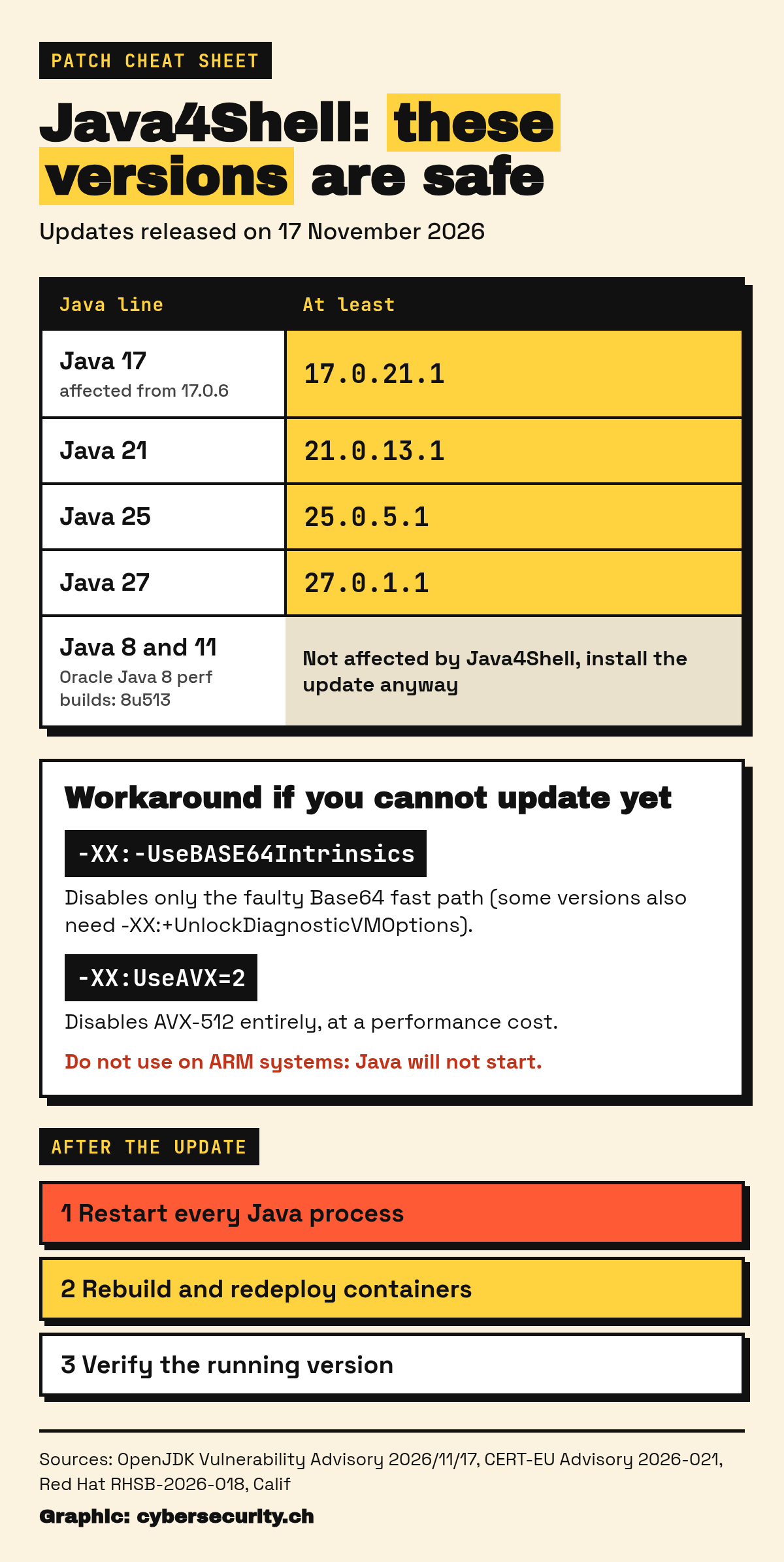
Three things are easy to miss in the rush. First, many products ship their own Java runtime, so an operating system update will not fix them. Atlassian, for example, plans to release Data Center patches and until then recommends switching off AVX-512 with a startup flag. Second, an update only takes effect after a restart, and containers have to be rebuilt. Third, the 17 November release also fixes nine other OpenJDK vulnerabilities, some of which affect Java 8 and 11. So the update is worth installing even where Java4Shell does not apply.
How do I check that the fix is in place?
On Linux, this command shows whether the CPU has the critical feature. If it prints nothing, the server is not affected by Java4Shell:
grep -o -w -m1 avx512vbmi /proc/cpuinfo«java -version» tells you whether the running Java build is patched. If you have applied the workaround, check it like this; the expected value is «false»:
java -XX:+PrintFlagsFinal -version \
  | grep UseBASE64Intrinsics
Check the process that is actually running, not your laptop. The Keycloak team explicitly reminds admins to check failover nodes too. Be careful with «-XX:UseAVX=2»: on ARM systems, Java will refuse to start with that flag.
Finally, a patch does not remove an attacker who is already inside. The NCSC recommends checking affected systems for unusual crashes, unexpected processes and suspicious activity. A Java service that has been crashing repeatedly since 17 November is a warning sign.
What applies in Switzerland if something does happen?
Operators of critical infrastructure must report cyberattacks to the NCSC within 24 hours of discovery. Whether that includes you is covered in our article on ISG, CSV and NIS2. If personal data is exposed and those affected face a high risk, the Federal Data Protection and Information Commissioner (FDPIC) must also be notified under Art. 24 FADP. For the first hours after a breach, see our 24-hour playbook.
Bottom line
Java4Shell hits a foundation that Swiss banks, authorities, hospitals and countless specialist applications run on. Whether a system is actually exploitable, though, comes down to a very specific mix of version, processor and data flow. Check the four conditions properly and you can tick off most systems quickly and focus on the few that matter.
The bigger lesson is the same as with the refrigeration cyberattack in Köniz: without an inventory, you spend the first day of an incident searching before you can start patching. An up-to-date list of where each Java version runs, and who owns it, will save days next time.
Sources
- NCSC: Java4Shell, critical Java vulnerability (18.11.2026)
- BACS: Sicherheits-Updates für Java angekündigt (17.11.2026, German)
- OpenJDK Vulnerability Advisory 2026/11/17
- Calif: Java4Shell technical write-up
- Red Hat: RHSB-2026-018
- VulnCheck: Java4Shell CVE-2026-114938 (17.11.2026)
- CERT-EU: Security Advisory 2026-021 (18.11.2026)
- CISA: Critical Java Vulnerability Requires Immediate Patching (17.11.2026)
- SecurityWeek: Java4Shell Exploitation Attempts Begin (19.11.2026)
- Keycloak: Java4Shell, what Keycloak admins need to do
- Jenkins: Mitigating Java4Shell (18.11.2026)
Stay informed
New analysis on cybersecurity in Switzerland, straight to your inbox. No spam, unsubscribe anytime.
